
Intentsify sponsored Advertising Week this year, and the same themes followed me from session to stage to booth: AI agents are moving into marketing and advertising workflows fast, and their success depends on the data behind them. Two moments brought that into focus: Snowflake’s session on what agents need before they touch a media workflow, and Deloitte Canada’s account-based marketing (ABM) case study.
What agents need before they touch a media workflow
The Snowflake session, “What AI agents need before they touch a media workflow,” started with an answer that cuts against the hype. An agent needs more than the latest model or a connection to an ad platform. It needs full business context, a cross-channel view of performance, and governed, privacy-conscious access to data.
Jason Dailey, head of North America agency at Meta, offered the clearest framing I heard all week: context, constraints, and consequences. Context is the data. Budget and margin are the constraints. Consequences are what you get out of an agentic workflow.
Getting context into the ad system is the hard part. Having enough data isn’t enough. It has to be high quality and structured so agents can use it, and the vendors that focused on that structure are the ones winning now. More companies are launching MCPs, which makes data more accessible and actionable, but agentic workflows only work when everything talks to each other.
It also addressed the job loss fear directly. The point of agentic workflows is to free teams from the constant monitoring and optimization media buyers handle, like weekly optimization flows, so they can spend their time on strategy. The opportunities discussed included:
- Automating the data, decisions, and levers behind weekly optimization
- Closing the creative loop by identifying what performed, regenerating new creative, and serving it
- Testing and operating at a scale manual teams can’t match
- Gathering more context before the media buy, not only optimizing after it
Startups are also trying to reshape the traditional media buying model with agentic ad platforms that put more control in the hands of whoever controls the spend, instead of the agency doing the work.
What agent-ready data looks like for B2B
Plenty of people talked about what agents make possible. Fewer talked about the data inputs that fuel them. That is where Intentsify has spent years, and our view is simple: data is the context layer for every go-to-market strategy, and it will make or break an agent’s success.
Agent-ready data meets five criteria, according to our recent webinar with Forrester:
- Accessible
- Legible, with a semantic layer that makes it understandable
- Trustworthy
- Resolved at the contact, buying group, and account levels
- Meaningful, with relevant insight for agents
Resolved is the one B2B teams tend to underestimate. An agent that can’t tell which contact belongs to which buying group at which account will act quickly on the wrong picture.
B2BMX: How Deloitte turned ABM into a growth engine
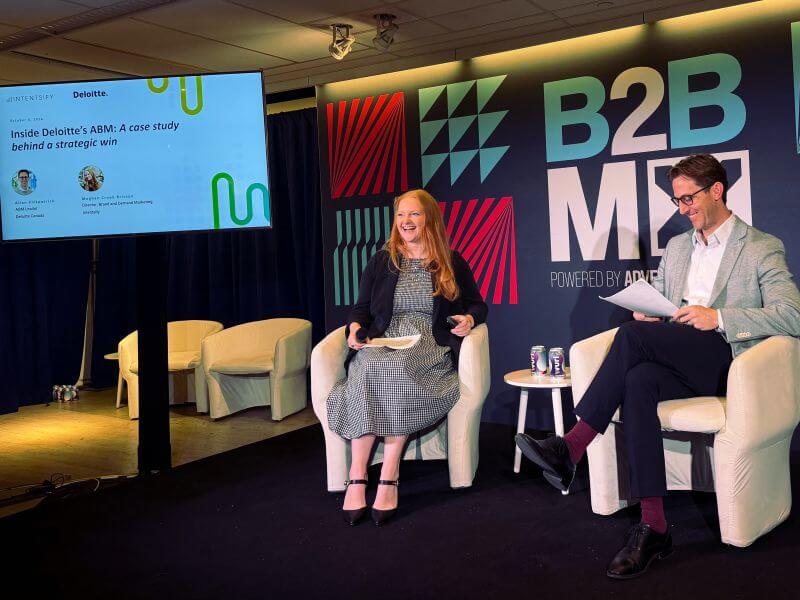
B2BMX was embedded in the larger Advertising Week event. We had a booth in the hub alongside other B2B brands, and B2BMX programmed focused B2B sessions on one of the stages. That is where I joined Allan Kirkpatrick, ABM lead at Deloitte Canada, to introduce his case study. Allan has spent 10 years at the firm and the last three building its ABM program from a one-person effort into part of the marketing stack. Our goal for the session was a clear takeaway: how to turn ABM from a marketing tactic into a business growth engine.
Allan started at the end, with a real case. An account was searching for a new financial statement auditor in an industry and region Deloitte wanted to break into. Deloitte hadn’t had a win there in a long time, the incumbent had been in place for years, and the client might decide not to switch at all. A highly structured procurement process meant Deloitte couldn’t email or meet with the client directly. ABM became the way to stay visible.
His team followed the same five steps they run on every pursuit: qualify, align, sense, activate, and measure. A few lessons stood out.
Qualify first, and get executive buy-in. Allan said the biggest ABM mistake isn’t poor execution, which gets easier downstream. It’s investing in the wrong accounts. Qualified accounts have an executive sponsor, a quantified growth ambition, a CRM entry or target deal size, a committed account leadership team, and the same KPIs as the business.
Shift from “tell us what we need to know” to “here’s what we know.” Deloitte runs two workshops with each account team. The first combines the team’s priorities and relationships with internal data, external buyer intent data, and competitor data, including data from Intentsify. It validates or challenges the team’s assumptions and sets a plan. The second, a speed to market workshop, refines tactics. Account teams own executive relationship plans and customized thought leadership, while the ABM team runs content syndication, geofenced programmatic display, digital out of home, connected TV, and LinkedIn. The two groups meet every other week, and every meeting starts with data.
Use data to create confidence, not complexity. When I asked Allan about his data strategy, he said partners already think they know everything, so the data has to be credible and selective. Bring the insight tied to a decision the team needs to make today, such as a competitor to counter, not everything you know.
The results, during a period when Deloitte couldn’t contact the client at all:
- 4.3 times the benchmark for programmatic display
- 25 percent above the benchmark on LinkedIn
- 15 director-plus leaders downloading content on audit capabilities and innovation, three of them from the C-suite
When Deloitte’s team presented its proposal, the client recalled the advertising without being asked. Deloitte won the audit, which is annuity business that spans multiple years. The lead partner credited ABM as a key driver in an email to stakeholders that reached the firm’s CEO.
Allan closed with three takeaways. Treat ABM as an account growth strategy, not a campaign. Start with accounts that are ready, because early wins buy you endorsement. And measure what the business measures. Deloitte’s ABM team is held to initiated and supported pipeline.
Advertising Week takeaways
The Snowflake session and the Deloitte case made the same argument from different directions. Allan’s team won because they brought credible, decision-ready context to the people who needed it. Agentic workflows will succeed or fail on the same thing. Models will keep improving. The teams that get their data accessible, resolved, and meaningful first will be ready to hand agents more responsibility.