
How Cox Business reimagined its go-to-market in six months, and what B2B marketers can learn from it.
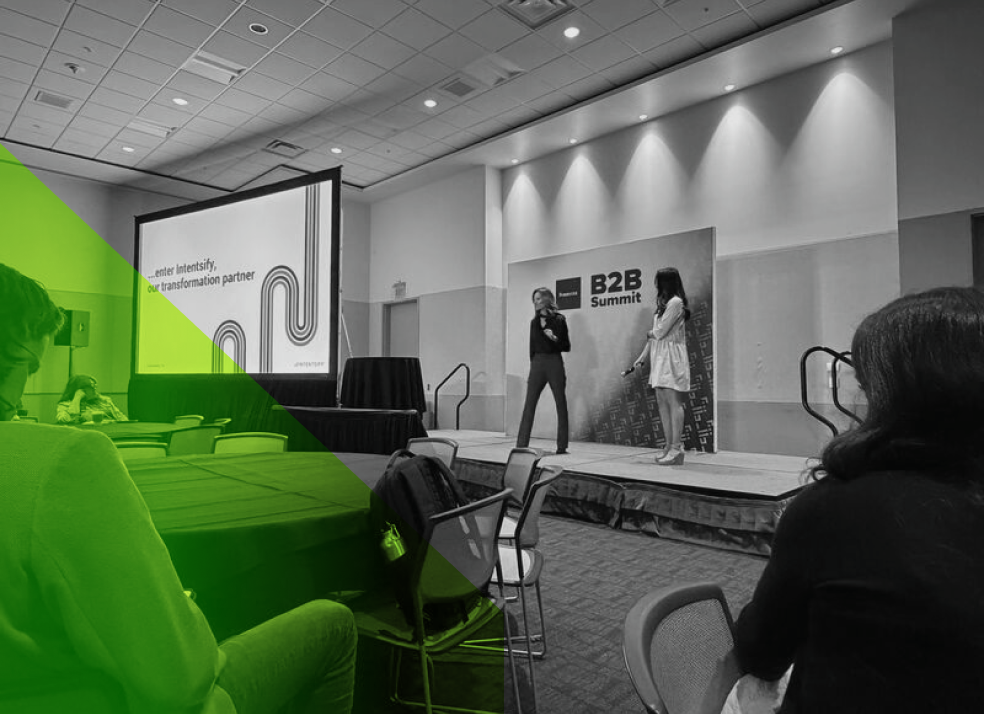
At this year’s Forrester B2B Summit, Intentsify VP of Marketing Hannah Swanson joined Sarah Kim, VP of Commercial Marketing at Cox Business (The B2B side of Cox Communications), for a live case study on what it actually takes to transform a legacy B2B marketing organization. No sanitized slides, no vanity metrics — just an honest account of challenges, hard pivots, and the results that followed. Here are the five key takeaways.
1. Traditional segmentation is leaving money on the table
Cox Business had long segmented its market the way many mature telcos do: employee count and number of locations. A single-location bakery and a single-location physician’s office received the exact same marketing treatment, despite having completely different connectivity needs, buying behaviors, and spending potential.
Sarah’s team used AI to analyze over 700 industry segments alongside data covering how customers bought, why they bought, and what they were buying. The result: nine distinct customer segments, each with unique demand spaces and positioning strategies.
The segments broke down into three broad tiers, each with different priorities. Value-led customers — think beauty salons and retail shops — care most about price and basic reliability. Performance-led customers, like restaurants, hotels, sports venues, and automotive businesses, need a higher level of reliability because their connectivity directly affects the customers they serve. High-tech customers, including physicians, banks, and software companies, rely on connectivity to power their core business and expect the most sophisticated solutions.
Price matters to all three. But leading with price alone when selling to a hospital or a sports venue means missing what actually drives their buying decision. Cox was doing exactly that, and leaving significant revenue on the table as a result.
The takeaway: If you’re segmenting on firmographic data alone, you’re underserving your highest-value customers.
2. Insight without activation is just an academic exercise
Sarah put it plainly: a beautiful segmentation model means nothing if your go-to-market motion can’t act on it. Cox Business ran a focused pilot on their highest-opportunity segment and built the entire execution around making the insight actionable. That meant propensity modeling, aligned trigger identification, co-developed offers, and fully synchronized sales and marketing activities.
For the first time, the email team, media team, and sales organization worked from a single source of truth toward one omni-channel campaign, rather than running in parallel silos.
The pilot validated the approach. Email open rates jumped by double digits. Click-through rates increased over 200 percent. Average deal size grew by 35 percent.
The takeaway: Segmentation earns its value only when it’s wired directly to how you sell. Marketing and sales alignment is the activation layer.
3. Scaling personalization requires AI, but the mindset shift comes first
After the pilot, the math got daunting fast. Scaling the new personalized approach across all nine segments would increase monthly campaign activity by 27 times and multiply sales enablement assets by 70. The team knew it wasn’t possible without AI. But Sarah was clear: adopting AI tools was the easy part.
The harder part was cultural. Cox Business didn’t roll out AI by simply asking people to upskill. Leadership started by instilling purpose and passion, positioning AI as a career differentiator and competitive edge, not a threat. From there, adoption became structured and mandatory. Every marketer set individual AI goals, enablement was required, usage was measured, and best practices were shared and celebrated across the organization.
The takeaway: AI transformation starts with people, not products. Purpose and passion have to come before tools and training.
4. True AI transformation means rebuilding, not retrofitting
Cox Business deliberately chose the harder path. Rather than layering AI features onto existing workflows, they used AI as the catalyst to redesign their entire go-to-market operation, from how campaigns are planned to how content is created to how leads are qualified.
One concrete example: lead data accuracy was sitting at just 18 percent. Through AI-powered enrichment and validation, that number climbed to 95 to 97 percent. Their content and messaging engine now ingests segmentation data, brand guidelines, legal requirements, and pricing information to generate campaign-ready content at scale — work that previously took weeks.
The takeaway: Thinking about AI as a series of point solutions is thinking too small. Real value comes from connected use cases working in concert across roles and workflows.
5. Knowing who to target isn’t enough. You also need to know when.
Even after all the segmentation work, pilot success, and AI implementation, Sarah’s team hit a persistent problem: timing. Campaigns were going out to prospects who had already bought. The right message was reaching the right person at the wrong moment.
This is what led Cox Business to partner with Intentsify. Standard intent data operates at the account level. Intentsify’s solution works at the persona level, surfacing individual buying signals within a target account. As one of Sarah’s team members put it: “It was like going from a Coach handbag to a Chanel handbag” when it came to intent.
The takeaway: Precision targeting without purchase-timing intelligence is still a guessing game. Persona-level intent data is the layer that connects great strategy to real pipeline.
Final thought
What Sarah Kim and the Cox Business team accomplished in six months is genuinely instructive: modern segmentation, full marketing and sales alignment, AI enablement across an entire organization, and a comprehensive cross-functional AI roadmap. But the most transferable lesson wasn’t tactical. It was this: real transformation requires the willingness to break what’s already there and rebuild it with intention.
Finding the right partner matters too. One of the reasons Cox Business chose Intentsify is that AI isn’t something we added on — it’s what we’re built on. Our intent data is powered by patented AI technology at its core, which is what makes persona-level intent signals possible in the first place. Most intent solutions tell you which accounts are showing interest. Intentsify tells you which personas within those accounts are actively in a buying journey, and surfaces the signals that show they’re ready to engage now. That’s what bridges the gap between great segmentation and actual pipeline.
As Hannah Swanson put it on stage: “Take that AI-first mindset, lean in, and look for partners to help you do that. Don’t get caught up in the ‘what ifs.’ Just go for it.”