Sectigo is a global leader in digital identity and certificate lifecycle management, helping organizations secure their web presence and connected devices. With more than 400 employees worldwide, the company serves businesses across industries ranging from financial services and healthcare to
manufacturing and the public sector.
The Challenge
For Dustin Woodul, Director of ABM and Customer Marketing at Sectigo, the hardest part of building a
B2B demand engine wasn’t the technology — it was focus.
When virtually every company with a web presence or managed devices is a potential customer,
“everyone is your customer” quickly becomes a targeting problem. When Dustin joined, demand
generation operated largely as spray-and-pray. AEs on the same team couldn’t agree on target account
lists. There was no unified ICP, no account prioritization framework, and no shared model to align sales
and marketing around a common go-to-market motion.
The existing intent data solution made things worse, not better. Built around individual contacts rather
than full accounts, it couldn’t reflect how security purchases actually happen: complex buying cycles
involving multiple stakeholders across security, IT, and DevOps. Sectigo needed a way to understand
whether an entire buying entity was in market, not just whether one person had clicked on something.
The Solution
Dustin had worked with Intentsify at a previous company and brought the partnership to Sectigo to
rebuild demand generation from the ground up.
Account prioritization and scoring
The team built a custom scoring model that combined Intentsify’s intent signals with six of Sectigo’s internal data points to tier and prioritize target accounts. For the first time, sales and marketing were working from the same list and the same logic.
Buying group intelligence for ABM
Rather than reacting to individual contact activity, the team tracked intent patterns across full buying entities, watching for surges in topics like identity management and certificate automation. SDRs worked directly inside the Intentsify dashboard, using account-level and persona-level signals to inform outreach timing and messaging, turning intent into context, not just a call trigger.
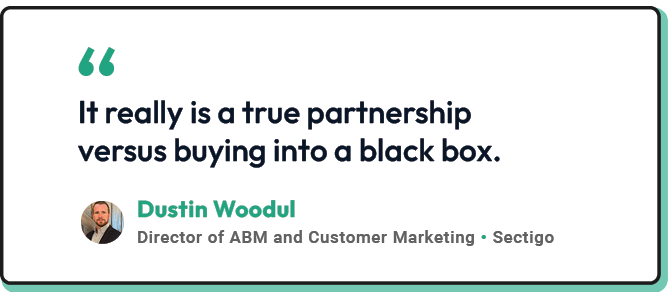
Think of it as breadcrumbs. You’re not flying blind, and Intentsify arms you to have a smarter conversation instead of just picking up the phone saying, ‘Hey, do you know about Sectigo?’ — Dustin Woodul, Director of ABM and Customer Marketing, Sectigo
Competitive and renewal intelligence
When major renewals came up, AEs and regional VPs came to Dustin’s team for intelligence briefings on which personas in the buying group were surging and on what topics. When competitor signals surfaced, sales got ahead of the threats before a renewal.
Content syndication, display, and cross-sell
Sectigo ran content syndication and programmatic display through Intentsify against its two primary go-to-market motions: the 47-day certificate mandate and private PKI cross-sell. Content syndication leads fed into downstream nurture, becoming audiences for webinars, roundtables, and field events. On the cross-sell side, intent signals around private PKI topics triggered targeted outreach to existing customers at the right moment.
Results
The most visible impact wasn’t a single campaign win, it was the structural shift underneath everything.
For the first time, sales and marketing were working from the same signals and account list, and measuring account readiness instead of just activity.
That alignment changed how the whole org operates. SDRs stopped working cold lists and started prioritizing accounts based on real in-market signals. Armed with buying group signals ahead of major renewals, sales teams walked into competitive conversations prepared rather than reactive.
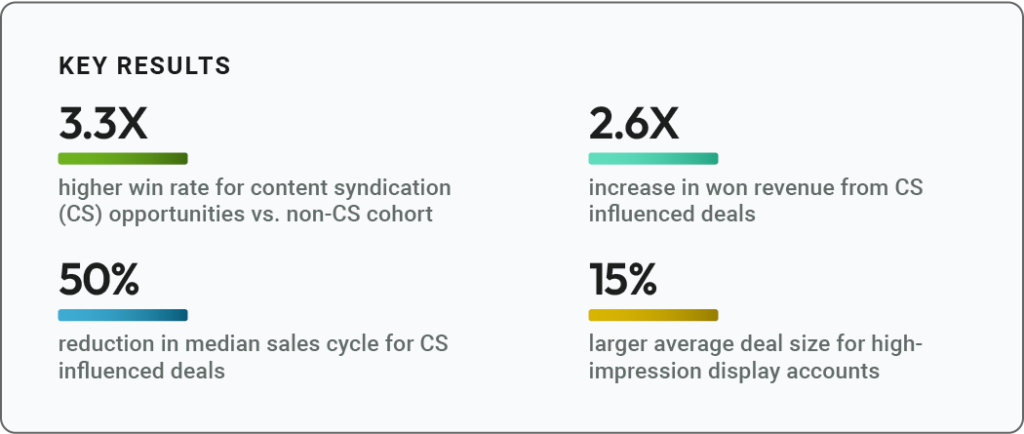
The content syndication numbers tell a particularly clear story. Opportunities influenced by content syndication converted to closed-won at 25.5%, compared to 7.7% for the rest of the book, a 3.3x lift in win rate. Those deals also closed 50% faster: 42 days versus 84. Content syndication isn’t just opening more opportunities, it’s delivering better ones, with higher win rates, shorter cycles, and over two times closed revenue from a comparable starting point in pipeline.
Display tells a similar story. In the cross-sell program, accounts that crossed the 200-impression threshold accounted for 63% of won revenue. Average deal size also ran 15% higher in that cohort. Consistent exposure isn’t just building awareness, it’s changing deal outcomes, especially when working together with content syndication.
Dustin is now building toward a formal marketing-qualified account (MQA) model and rolling out podbased selling with Intentsify data at the center, a sign that the program has matured from a demand gen fix into a foundation for how Sectigo goes to market.