This company is the B2B division of one of the largest privately owned telecommunications companies in the United States. The company empowers over 400,000 organizations with secure, scalable, custom-built connectivity solutions across a broad range of industries, from small local businesses to large enterprise and public sector customers. They deliver the reliable infrastructure that keeps businesses connected, operational, and competitive.
The Problem
The company had a go-to-market strategy that wasn’t keeping pace with the complexity of its customer base. Marketing operated as a shared service across residential and business divisions. B2B marketing was consistently under-resourced and shaped by a consumer lens that didn’t reflect how business customers actually buy.
On top of that, the team was simultaneously navigating a major tech stack overhaul, a full remapping of sales territories, and growing pressure to do more with less amid budget cuts.
But the most fundamental issue was this: the company segmented customers by employee count and number of locations, then marketed to all of them the same way. A neighborhood bakery and a regional hospital received the same message, the same offer, and the same treatment — even though what those businesses actually need from a connectivity provider looks nothing alike. Price matters to every customer, but for many businesses, reliability, performance, and advanced technical capabilities are far more important buying criteria. By ignoring those differences, the company was underserving its highest-value segments and leaving significant revenue on the table.
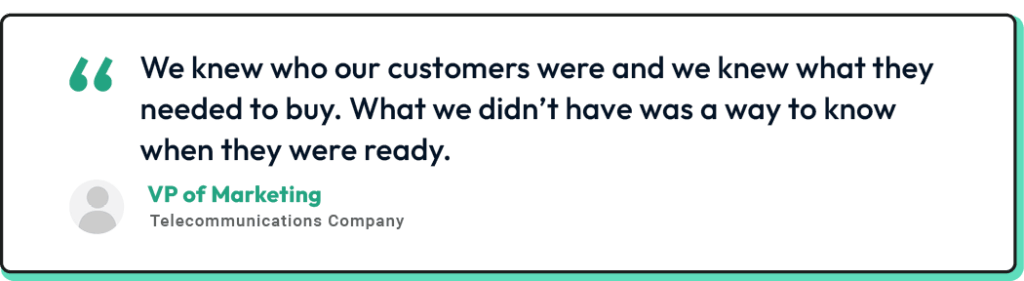
There was also a timing problem. Even with the right customer and the right message, the team had no reliable way to know when that customer was ready to buy, leading to wasted spend and campaigns that reached prospects who had already made a purchase decision.
The Solution
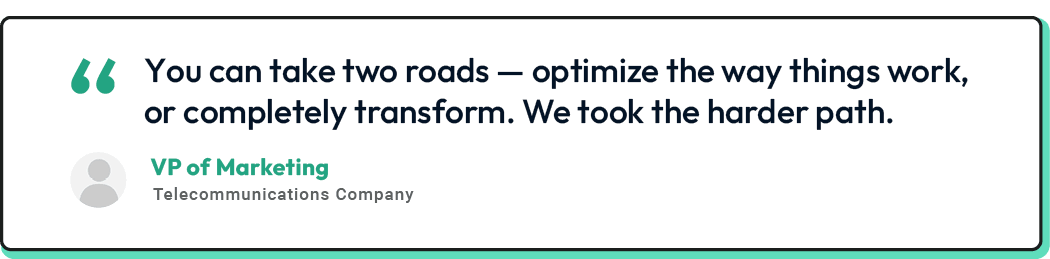
The VP of Marketing recognized the team was at an inflection point. Rather than optimize the existing approach, she chose to rebuild it entirely, starting with the customer.
Modern segmentation powered by AI
Using AI to analyze over 700 industry segments and hundreds of thousands of data points covering how customers bought, why they bought, and what they bought, the team developed nine distinct customer segments.
Those segments were organized into three meaningful tiers.
- Value-led customers, like retail shops and beauty salons, prioritize price and basic reliability.
- Performance-led customers, including restaurants, hotels, sports venues, and automotive businesses, depend on connectivity to directly serve their own customers, making a higher tier of reliability non-negotiable.
- High-tech customers, including physicians, banks, and software companies, expect the most sophisticated, tech-forward solutions available.
For the first time, the company had a clear, data-driven picture of who its customers were, what actually mattered to them, and how to position its solutions differently across segments.
A focused pilot to prove the model
Rather than rolling out the new approach across the entire business at once, the team ran a focused pilot on their highest-opportunity segment. Sales and marketing worked from a single source of truth, co-planning campaigns, aligning on target accounts, developing industry-specific messaging, and syncing sales enablement with marketing activity. The team ran a true omni-channel effort, breaking down the silos that had previously kept the email, media, and sales teams operating independently.
AI-powered execution at scale
The pilot validated the approach, but also made the scaling challenge clear. Taking the personalized model across all nine segments would require 27 times more monthly campaign activity and 70 times more sales enablement assets than the team could produce manually. The answer was AI — but not as a bolt-on tool.
The company took a cross-functional approach to AI transformation, redesigning workflows rather than
layering new features onto old ones:
- Built a unified knowledge base as a central repository for go-to-market execution.
- Deployed an AI-powered content and messaging engine that ingests segmentation data, brand guidelines, legal requirements, and pricing to generate campaign-ready content at scale.
- Used AI to repair lead data quality, lifting accuracy from 18 percent to 95 percent.
- Required every marketer to set individual AI goals, complete mandatory enablement, and take direct accountability for adoption and results.
Intentsify as the intent layer
To solve the timing problem, the company partnered with Intentsify.
Where most intent solutions operate at the account level, Intentsify’s AI-powered solution surfaces buying signals at the persona level, identifying which personas within a target account are actively researching and when they’re ready to engage. The company now had the final piece needed to connect strong segmentation and personalized content with real purchase intent.
The company designed a full-funnel program with Intentsify across four dimensions:
- Identification — Custom intent models determined which accounts were actively in-market, mapped directly to the company’s nine customer segments so targeting aligned with how the team actually goes to market.
- Activation — Display and CTV campaigns, alongside an intent-driven content syndication program, delivered segment-specific content and messaging to the right accounts at the right time.
- Verification and scoring — Intentsify’s tele-qualification process filtered and validated engaged contacts, ensuring only the highest-quality leads moved forward. Contacts entered the company’s email nurture program.
- Pipeline conversion — Verified leads were handed off to the SDR team to convert into SQLs and build pipeline.
Results
In six months, the company rebuilt its go-to-market from the ground up. The results from the initial pilot made the case clearly.
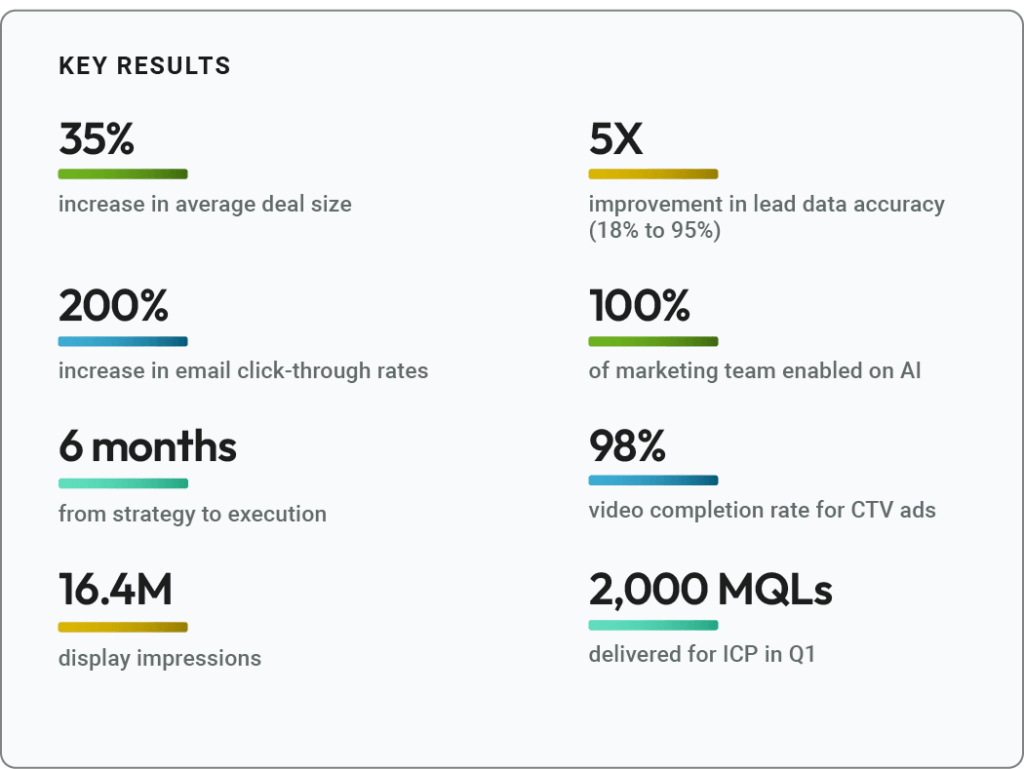
Beyond the numbers, the company now operates with a fundamentally different go-to-market model. Sales and marketing work from a shared foundation, segmentation connects directly to how the team executes, and AI runs across strategy, content, campaign planning, and sales enablement.
The Intentsify partnership has extended beyond program execution, with consistent weekly reporting and insights, proactive lead quality reviews, SQL qualification frameworks, and lead summaries that give sellers more context for every conversation.