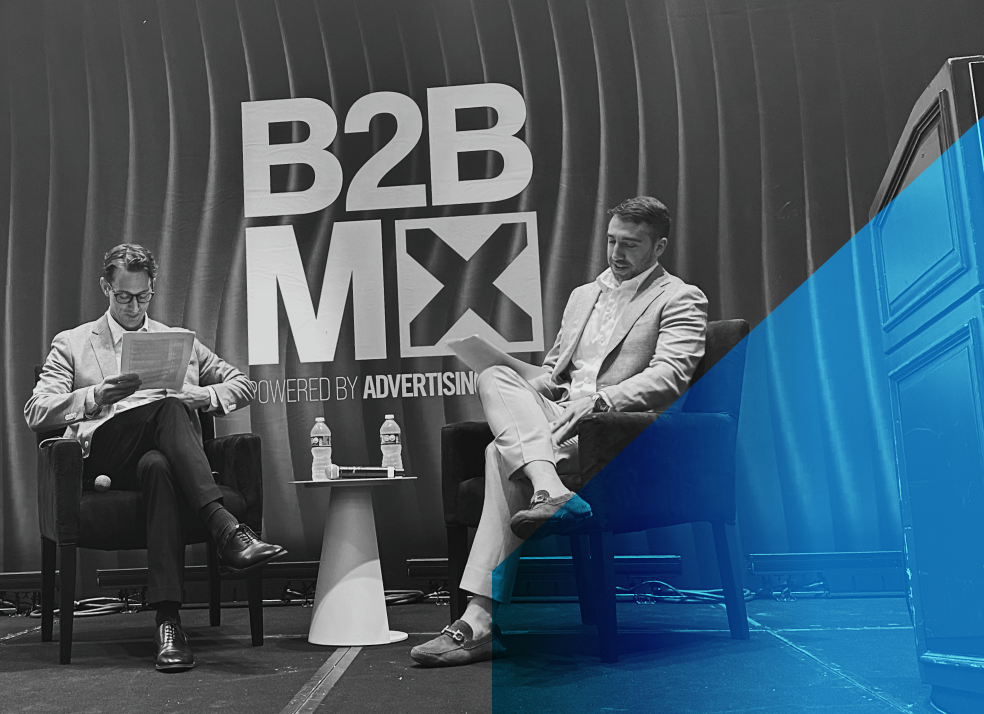
A recap of the B2BMX session featuring Allan Kirkpatrick from Deloitte and Joey D’Agostino from Intentsify
If you’ve ever tried to stand up an Account-Based Marketing program inside a large enterprise, you know that the hardest part isn’t the strategy, it’s everything that comes after it. At this year’s B2BMX conference, Intentsify’s Joey D’Agostino sat down with Allan Kirkpatrick, a marketing leader at Deloitte, for a candid look at what it actually takes to build ABM at scale inside a $70 billion professional services firm.
A Program Built Twice
Allan’s ABM journey at Deloitte spans more than a decade, but the current program is really a second chapter. About five years ago, he led an early ABM effort that showed early promise until COVID brought it to a halt. When the firm decided to revisit ABM 16 months ago, Allan raised his hand again, describing it as “unfinished business.”
That persistence has paid off. What started as a fragile internal experiment has evolved into a formalized program with defined KPIs, dedicated tooling, and growing organizational buy-in.
How ABM Works at Deloitte
Deloitte’s approach to ABM is shaped by a structure that already exists within the firm. Rather than building an account list from scratch, the ABM program works around what Deloitte calls “chosen clients,” roughly 100 strategically prioritized accounts, with about 10 receiving the deepest focus. The program also supports the firm’s largest active deals on a rotating quarterly basis.
The program is measured against four KPIs:
- Initiated pipeline — opportunities that would not have existed without ABM
- Win rate — supporting the closure of large deals
- CXO relationship depth — measuring the quality of executive-level engagement
- VP+ contact growth — expanding the breadth of senior relationships within accounts
This combination of growth, deal support, and relationship metrics reflects ABM’s unique position within Deloitte’s marketing organization — one that bridges demand generation and account management.
The Challenges of Getting There
Standing up the program wasn’t without friction. Allan pointed to two primary challenges early on.
The first was the internal business case. ABM is inherently more expensive on a per-contact basis, and proving ROI before results materialize requires patience and persuasion. The second challenge was internal alignment. Not all account teams are built the same way, and not all of them were ready to partner with an ABM program. Some clients were in the wrong stage of their buying cycle. Others simply didn’t have the right fit.
To address this, Deloitte built a two-part intake system that helps account teams identify which focus areas are truly ABM-ready, and just as importantly, which ones aren’t. This structured approach allowed the program to scale more efficiently by focusing energy where it could actually move the needle.
Intent Data as an Internal Credibility Tool
One of the more compelling moments of the session was Allan’s description of how intent data changed the dynamics of internal stakeholder conversations.
Using intent data from Intentsify, Allan’s team was able to walk into account planning meetings with something no one else in the firm could offer: a near real-time view of what accounts were actively researching including competitor activity and topic consumption patterns. They built a heat map template that mapped account team priorities against intent signals, giving marketing a data-backed perspective on where to focus.
The effect was immediate. As Allan described it, intent data moved the dynamic from “tell us what we need to know” to “here’s what we know.” This was a fundamental shift in how marketing was perceived. Account leaders who were accustomed to running those conversations solo started leaning in, asking questions, and treating marketing as a peer.
The lesson here is an important one: data only creates alignment when it’s operationalized and delivered in a format the right people can actually use.
AI in the ABM Workflow
AI came up throughout the session, and Allan offered a grounded, practical take on where it’s actually adding value today versus where Deloitte is still experimenting.
Current applications include:
- Faster research and topic upskilling — helping the team quickly get up to speed on complex client industries like SAP implementations or finance transformation
- Creative acceleration — faster briefs, social copy, and ideation to get campaigns closer to a final product sooner
- Personalized outreach support — using AI to help craft tailored emails for account teams, connecting specific client pain points to relevant thought leadership
Importantly, Allan was clear that AI-generated copy doesn’t go straight to market. The goal is to get the team “halfway there,” with humans refining the voice, tone, and authenticity from there.
Looking ahead, Deloitte sees AI as a way to extend the reach of the marketing team, not to replace people, but to bring ABM-quality support to more of the business’s internal entrepreneurs and practitioners who currently go without it.
The Agile Advantage
One of the more underrated shifts Allan highlighted was the adoption of agile marketing practices over the past year. Breaking down silos between copywriters, creatives, and campaign managers has dramatically compressed time-to-market.
A standout example: Deloitte and Intentsify partnered on a geofencing-based display campaign targeting attendees at a conference. The goal was to surround the venue and reach the right individuals at exactly the right moment. What made it possible, was Intentsify’s device-level targeting capability, which uses an identity graph to identify and reach individual mobile phones, tablets, and computers belonging to the target audience. Rather than casting a wide net, the campaign was able to zero in on specific blocks around the venue and serve ads directly to the devices of key decision-makers in attendance.
From idea to live campaign took three days. Joey D’Agostino noted that the team identified the opportunity on a Monday and was in market by Wednesday — inclusive of strategy, creative, and activation. For a firm of Deloitte’s size, that kind of speed is remarkable, and it’s a direct result of both the agile operating model and the flexibility of Intentsify’s targeting infrastructure. And the results backed it up. Campaigns run in support of large deal pursuits using intent-driven targeting saw marketing engagement running 4-5x above standard benchmarks.
Three Pieces of Advice for ABM Practitioners
Whether you’re just starting out or trying to scale an existing program, Allan offered three practical recommendations:
1. Align on a small number of KPIs early. Don’t try to do everything. Get crisp on how the program is measured and how it helps. Then make sure your business partners understand it in those terms. Clarity creates momentum.
2. Rally around an early win. Find the story that’s starting to bubble up and over-invest in it. One marquee internal moment, with a champion willing to speak to it, is worth more than spreading your efforts thin across a dozen accounts.
3. Define what ABM means for your organization. Cut through the noise. Pilot small, measure rigorously, and let the data guide how you scale. The best ABM programs are the ones designed around your specific business, not someone else’s case study.
What’s Next
Deloitte’s ABM roadmap is focused on three areas: integrating ABM with the firm’s broader brand campaign for a true full-funnel approach and expanding account-based experiences and client delight experiences that go beyond traditional marketing.
That last point was one Allan clearly felt strongly about. He wants this program to outlast him — to be documented and handed off to a team that can take it further. Moving away from what colleagues affectionately called “Allan-based marketing” and toward something that truly belongs to the organization.