
You don’t need to be a mind reader to create content your audience is interested in, but it helps if you act like one. That’s where an intent-driven strategy comes in handy.
Most marketing teams still build content calendars the old-fashioned way: brainstorm ideas, plug them into a spreadsheet, and hope something sticks. The problem? Your buyers have already moved on to the next question, problem, or comparison before your blog ever goes live.
An intent-driven content engine flips that model around. Instead of guessing what people might care about, you tap into what they’re already searching, reading, and researching right now, and you respond with timely, tailored content that meets them where they are.
Below, we’ll break down what “intent data” really means, where to find it, how to use it, and how solutions like Intentsify can help you turn all that information into a living, breathing editorial system that powers the pipeline.
Step 1: Understand What Intent Data Actually Tells You
“Intent data” sounds complex, but it’s really just a collection of signals that someone is in a particular mindset or stage of the buying journey.
Broadly, intent data falls into three buckets:
- First-Party — Online research activities observed directly by your own website, landing pages, social media profiles, CRM, marketing automation platform, etc.
- Second-Party — Signals observed directly by another party’s owned media properties and databases, such as G2.
- Third-Party — Intent data sourced by an external partner, such as Intentsify.
Together, those signals reveal why people are consuming content, not just what they’re reading.
Here’s a quick way to think about it:
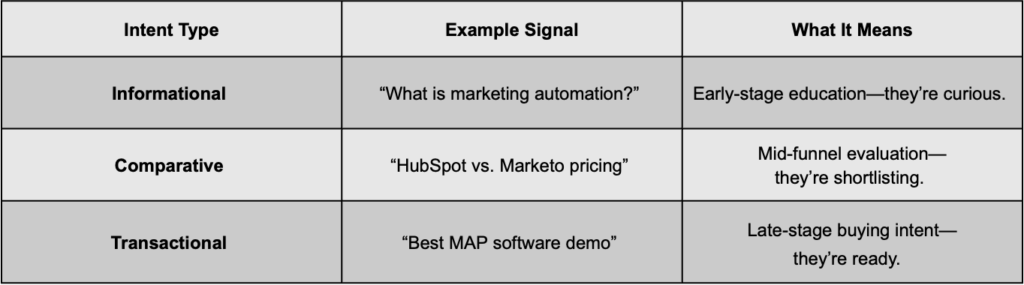
If your content engine can detect and serve each of these stages, you’ll never wonder what to publish next; your audience will tell you.
That’s also where Intentsify shines. It detects when entire buyer groups inside your target accounts start researching the topics and value propositions that make your solution unique. Instead of reacting to individual clicks, you’re analyzing collective intent, and that’s the real game-changer.
Step 2: Form a Clear, Complete View of Intent Signals
You don’t need to be everywhere; you just need the right signals. Focus on combining multiple sources for the most comprehensive, actionable insight:
1. First-Party Data
Pull from your analytics platforms, social dashboards, and CRM reports. This shows you how buyers are engaging with your content and programs — which topics, tones, and formats actually hold attention. First-party data can help you pinpoint signals that indicate late-stage research — for example, visiting your website product pages for information about your solution.
2. Second-Party Data
Sites like G2 can provide insights on specific types of behaviors, such as vendor comparisons. Others can surface intent signals for very niche audiences such as IT professionals that are a member of the publisher’s network. This helps you refine your targeting and messaging for specific segments.
3. Intent Data Providers
This is the secret weapon as third-party data offers the highest volume of signals, which improves data accuracy and coverage. Solutions like Intentsify monitor behavioral signals across trillions of digital touchpoints to detect when specific companies, buyer committees, and even personas are in research mode.
Intentsify helps teams:
- Spot real-time buying group activity across in-market target accounts.
- Identify the intent signals most relevant to your unique offerings
- Understand which topics are surging, which roles are driving the conversation, and interest level of the buying group
- Prioritize who to engage, and with what message.
No guessing. Just signals that say: “Hey, this topic matters to your market right now.”
Step 3: Build an Intent Framework (So You Know What to Do With It)
Data is only valuable if it leads to action. So, give it structure: Signal → Insight → Action. Follow these steps:
- Collect — Gather intent data.
- Cluster — Group topics by theme (e.g., “AI in marketing,” “pipeline acceleration”).
- Map — Align topics to buyer research stages.
- Respond — Create or update content that moves buyers forward.
- Measure — Track engagement, velocity, and conversions tied to those themes.
Here’s a quick example:
You notice multiple accounts surging around “marketing automation platforms” on Intentsify.
- That’s your cue.
- Intent signals surface for topics that align with your unique solutions like “multichannel engagement” and “advanced marketing analytics.”
- You map it to mid-funnel evaluation.
- You respond with a comparison guide or a checklist.
- You measure which format drives demos or downloads.
You’ve just turned raw intent into a targeted content move.
Step 4: Create Content for Every Stage
Your audience isn’t monolithic. Some are discovering, some comparing, and some ready to buy. So, your content engine needs to cover all research stages:
1. Awareness
- “What is” guides, analyst reports, infographics, blog posts.
- Goal: Build trust and awareness of market problems, challenges, opportunities.
- Example: “3 Key Factors Impacting Your Marketing Performance”
2. Interest
- Articles, analyst reports, playbooks, webinars.
- Goal: Help educate buyers about ways to address their challenges or improve the way things are being done.
- Example: “The Guide to Fixing Your Broken Marketing Funnel”
3. Consideration
- Guide, eBooks, reports, webinars, case studies.
- Goal: Educate buyers about solution categories – what the value is, how it works, who uses it, etc.
- Example: “How to Accelerate Pipeline with the Right Marketing Automation Platform.”
4. Decision
- Case studies, ROI calculators, product sheets, demo videos, testimonials, product reviews.
- Goal: Promote your products and services and highlight your value propositions, differentiators, and proof points.
- Example: “How Hubspot Helps Marketing Teams Generate Pipeline That Converts.”
A balanced mix keeps your funnel healthy and your brand relevant — no matter where buyers land.
Step 5: Use Intent Data to Plan Content Proactively
Traditional content calendars are rigid. Intent-driven ones are living and breathing.
Here’s how to shift from editorial schedule to intent engine:
1. Map Content to Buyer Personas.
Problem identification → solution exploration → requirements → selection.
Intentsify’s topic clusters can help pinpoint which stage is gaining traction across accounts so your content fits that journey.
2. Run a Monthly “Intent Pulse.”
Use Intentsify to identify trending topics and accounts in your market. Are security leaders showing interest in “cloud migration”? Are CFOs diving into “cost optimization”? Those themes go straight into next month’s lineup.
3. Layer in Evergreen Content.
Core topics like “how to improve your marketing automation” still matter — refresh them using current intent data to match the market’s language.
4. Collaborate Cross-Functionally.
Share your intent findings with sales and customer success. If a new topic is trending, arm your teams with fresh talking points and content links.
With a system like this, you’re not playing catch-up — you’re setting the pace.
Step 6: Close the Loop Between Data and Content
An intent-driven strategy isn’t a one-off campaign – it’s a feedback system.
- Weekly Check-ins: See what new topics are surging.
- Monthly Content Review: Evaluate which intent-aligned assets drove the most engagement or pipeline. Identify gaps in your content strategy based on the top topics your target accounts are researching.
- Quarterly Refresh: Retire underperformers, expand high-intent winners.
- Internal Enablement: Share insights across marketing, sales, and leadership. When everyone knows what the market is talking about, messaging stays consistent.
Over time, you’ll start predicting content demand instead of reacting to it.
Step 7: Scale with Technology (and Stay Human)
Manual intent tracking gets messy fast. Automation keeps your system humming.
Here’s what a modern tech stack might look like:
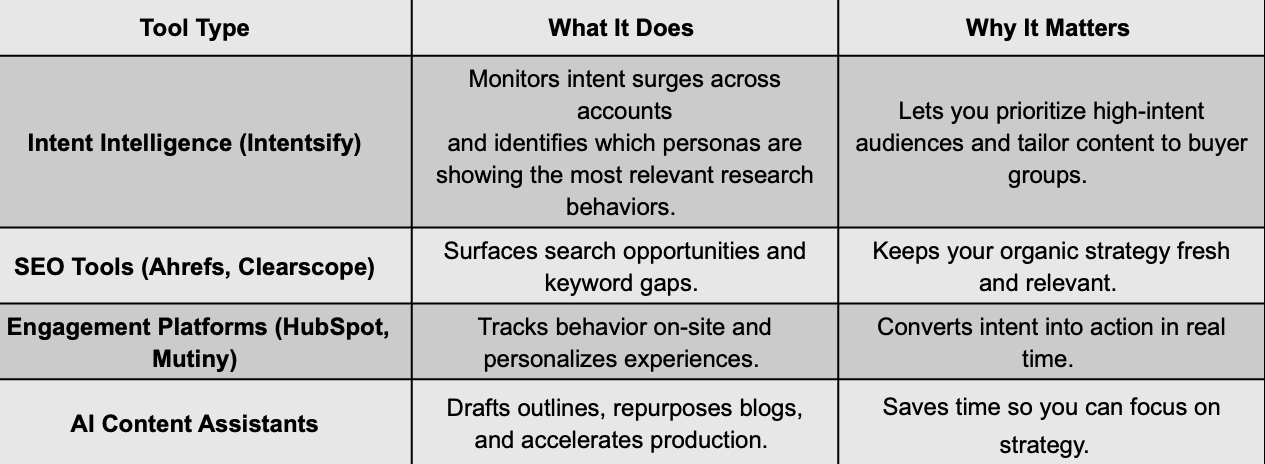
But remember: technology amplifies great strategy; it doesn’t replace it. Your human insight, empathy, and creativity are what turn signals into stories.
Step 8: Measure What Actually Matters
Intent data isn’t about vanity metrics;, it’s about momentum. Here’s how to measure success beyond clicks:
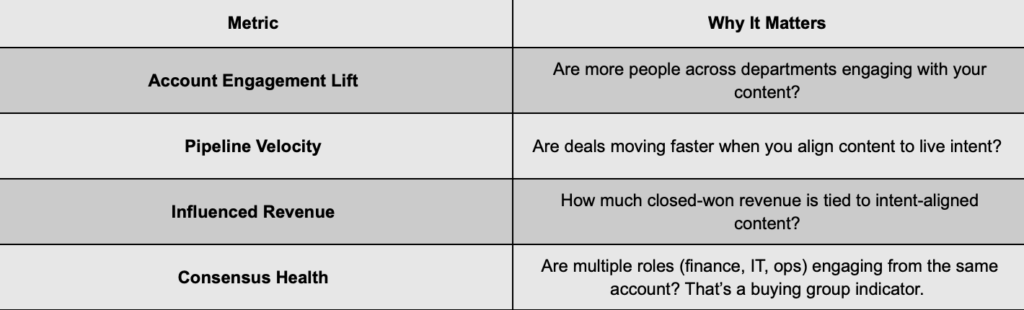
Platforms like Intentsify make these patterns visible — tracking not just what content performs, but who it’s influencing inside an organization. That visibility bridges the gap between marketing and sales.
Final Thoughts: From Reactive to Predictive Content Marketing
Most brands create content after the market moves. Intent-driven ones move with it — sometimes even ahead of it. When you combine search demand, engagement metrics, and intent intelligence from platforms like Intentsify, you stop guessing what people want to read and start anticipating what they’ll need next. You’ll know which topics are heating up, which buyer groups are active, and what pain points are pushing decisions. And that means you can publish the right content, for the right audience, at the perfect moment, — before your competitors even notice the signal.
That’s the power of an intent-driven content engine: it doesn’t just react to demand; it creates it.
FAQs
Beyond vanity metrics, how does an intent-driven content strategy directly impact pipeline velocity and influence revenue growth?
An intent-driven strategy focuses resources only on topics actively researched by high-intent buyer groups. This accelerates pipeline velocity by ensuring that the right content reaches the right stage of the journey faster. It influences revenue by creating clear, trackable links between intent-aligned content consumption and closed-won deals.
What is the most critical first step our team must take to successfully launch an intent-driven content program?
The critical first step is establishing a structured Signal → Insight → Action framework (Step 3). This ensures your team moves past data collection and establishes a process for clustering topics, mapping them to buyer stages, and creating a content response, guaranteeing that every signal leads to a measurable content action.
How does leveraging a platform like Intentsify differentiate our content strategy from competitors who rely on traditional intent methods?
Intentsify provides collective intent by monitoring buying group activity across accounts. While competitors react to individual clicks, you are proactively responding to the surging needs of entire buyer committees. Intentsify’s solution-aligned signals also help you eliminate the noise and focus only on research behaviors that are relevant to your business. This allows for superior content personalization, better sales prioritization, and a significant time-to-market advantage on trending topics.