The old strategies of mass outreach and simple retargeting just don’t cut it anymore. Today’s buyers expect a seamless, personalized experience that mirrors the best of B2C. To gain an edge, you have to be relentlessly creative and data-driven. At Intentsify, we’ve learned that truly outstanding buyer journeys begin and end with precision, and that precision is powered by intent data.
This is the second installment of our B2B playbook, “How Intentsify Uses Intentsify,” where we pull back the curtain on how our own demand generation team has evolved its strategy. The core takeaway? We’ve moved past only targeting accounts that show intent to launching hyper-specific, persona-level programmatic campaigns. Here’s how you can replicate our success through an intent-powered demand gen strategy.
Why Shift to Persona-Level Intent Targeting?
Since releasing the first edition of “How Intentsify Uses Intentsify,” we launched persona-level intent, and it has completely changed our approach to demand generation. Previously, our programs were focused on accounts that showed intent. Now, we can drill down to reach only the specific buying group personas we care about and adjust the messaging for each program accordingly. This ability to market to individual personas influences every step of the customer journey, establishing a unique level of trust because our audience recognizes that we genuinely understand their daily challenges.
Think about a high-level financial buyer like the CFO. They aren’t typically the ones requesting a demo. But building brand awareness amongst this key stakeholder is crucial to winning a deal.
For example, our demand gen team now runs display campaigns aimed only at the CFO persona at our target accounts. The message is direct: “Your ABM platform costs too much.” This message would never resonate with a demand generation buyer, but it absolutely gets the attention of finance. We never want the contract to be the first time finance or procurement hears about our brand.
How Do We Use Programmatic Campaigns to Reach the Whole Buying Group?
B2B buyers aren’t just roles and job titles—they’re real people. Reaching them means expanding our digital strategy beyond their desktop and the traditional nine-to-five workday. We recognize the necessity of meeting buyers where they are: often on their mobile devices, in their cars, or at home on the couch.
To achieve this, Intentsify invested heavily in enhancing the digital ad formats available to our customers. Now, we have the ability to launch intent-driven Connected TV (CTV), streaming audio, and even podcast ad reads.
Experimenting with these new formats and gaining air coverage on what have historically been B2C channels has dramatically impacted our ability to reach our audience exactly where they’re paying attention. Digital makes our brand feel bigger, and it’s all about presenting our value proposition in environments largely dominated by B2C advertising.
The Intent-Powered Retargeting & Nurture Strategy
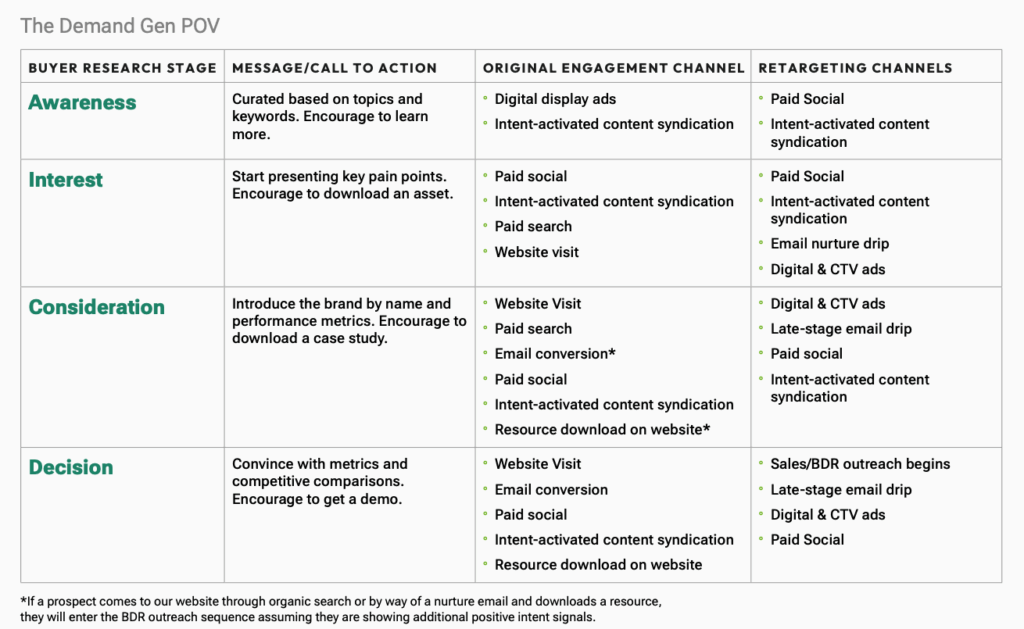
Our demand gen team adheres to a strict brand-to-demand framework. We ensure that the audience being targeted with lead generation programs is also being served digital ads. This ideology of “always on, everywhere” encourages them through the buyer journey.
We think about retargeting in terms of the buyer journey stages and work hard to ensure a “surround sound” approach to our marketing and advertising efforts. This means our messaging transitions based on the stage:
Moving Beyond Basic Channel KPIs
As a marketing executive, you know that CTR and click volume have no place in a leadership meeting where marketing performance is being scrutinized.
Instead, we focus on coverage and influence:
- What percentage of our target account list has been served and/or engaged with one of our ads?
- Of the closed/won deals in the past quarter, how many have been targeted with an ad?
Proving positive performance on brand awareness channels will always be an uphill battle, but positioning influence over attribution is always a better angle.
See how our teams use this exact framework to build buying groups, surround accounts, and power pipeline in our eBook, “How Intentsify Uses Intentsify: Volume II.”
FAQs
How do we measure the ROI of the “Surround Sound” approach when running Programmatic Campaigns across CTV and audio?
We move away from last-touch attribution and focus on influence and coverage. We measure what percentage of our closed/won deals were targeted with an ad and calculate the lift in key, high-intent activities (like website traffic from target accounts/personas) following exposure to the campaign. This allows us to prove positive performance on brand awareness channels.
What is the most effective messaging difference when shifting from account-level to persona-level intent targeting?
The difference is specificity and relevancy. For persona-level targeting, you can tailor the message to the specific daily challenges of that role. For instance, a campaign targeting a demand gen persona might focus on “pipeline velocity,” while a campaign targeting the CFO focuses on “cost efficiency.”
Does this approach replace traditional B2B channels like content syndication and paid search?
No, it enhances them. Our approach is a “surround sound” model that incorporates multiple digital channels to ensure we are always on, everywhere. Intent-activated content syndication and paid search are core channels for generating leads; the programmatic campaigns (Display, CTV, Audio) ensure the entire buying group is educated and familiar with our brand long before a deal gets to the contract stage.