
The Good, the Bad, and What to Expect
Connected TV is coming up more often in conversation within GTM teams, but not because it’s the new shiny thing in advertising. It’s having a moment because it represents a shift in how audiences consume content and how marketers can access, influence, and convert them. Despite CTV’s rapid adoption, most teams still treat it like traditional television with a digital buying mechanism. That mindset misses the channel’s full value.
CTV is not “TV you buy programmatically.” It’s not linear with better targeting. It’s not a YouTube alternative. It’s a sophisticated, data-responsive, intent-fueled performance layer that behaves more like paid search than traditional broadcast, but only if you operate it correctly.
We’re not here to define CTV for the 30th time. We’re giving you the strategic, operational, and practical clarity that most marketers never get when they enter the space. Think of this as the briefing you need before spending your budget on connected TV.
CTV Is Not Just Another Screen
The reason CTV matters more now than ever is the near-total, permanent reallocation of attention from cable toward streaming environments. And this migration didn’t happen evenly across demographics; it happened quickly among the audience segments B2B marketers care about most: professionals and decision-makers.
CTV sits at the intersection of two things modern marketing desperately needs more of: attention and accuracy. It delivers the full-screen, high-impact experience of television, but with digital-level fidelity and control. Because the experience is largely non-skippable, a brand gets 15 or 30 seconds of uninterrupted mindshare that most channels can no longer offer.
But again, the real advantage isn’t the screen. It’s the strategy behind it.
Traditional TV forced you to target a program. CTV allows you to target a person, and more specifically, the right person at the right company, with the right intent signals. That’s the strategic unlock that we haven’t seen before on a channel of this caliber.
How CTV Actually Works
If you’ve heard the simplified version, “define a target audience, buy premium inventory, measure results,” you’ve heard the marketing-friendly explanation, not the operational truth. Let’s pull back the curtain.
A CTV campaign begins with audience design. And this is where CTV can use either a scalpel or a sledgehammer. The quality of your audience determines whether you’re paying to reach an actual buying committee or just burning impressions across households that happen to match a broad demographic.
B2B marketers have an advantage here that wasn’t possible five years ago: intent data. When you combine a named account list with verified research activity (buyers actively exploring solutions like yours), you get a level of targeting that television has never offered. Your ads don’t simply go to “IT directors at companies with 500+ employees.” They go to IT directors at companies researching cloud security right now.
Once the audience is set, CTV buying takes place in real time, which surprises many marketers. They assume CTV behaves like traditional upfront commitments, but premium CTV inventory is purchased through programmatic marketplaces that allow real-time bidding on available ad space.
This is why CTV is so powerful when deployed correctly, but it also explains why poorly defined targeting, restrictive network blocks, or mismatched KPIs can suffocate performance before a campaign even launches.
The Problem With How Most Teams Approach CTV
Let’s be honest: many marketers enter CTV with incorrect expectations. They expect last-touch conversions. They expect a click. They expect the platform to behave like social media. And when that doesn’t happen, they assume CTV “isn’t performing.”
It’s time to shift that mindset.
CTV is designed to influence behavior, increase awareness, shape perceptions, and drive downstream engagement. Attributing a pipeline conversion directly to a CTV impression is like crediting the first discovery call for a closed-won deal. It’s directionally true, but tactically incomplete.
What you can measure (reliably and meaningfully) is completed views, household reach, frequency, site visits after viewing, active account engagement, and lift in pipeline velocity. These are signals, not endpoints. And when CTV is part of an orchestrated, multi-channel strategy, these signals don’t just indicate success; they amplify it across everything else you’re running.
CTV makes display smarter. It increases search demand. It warms up social retargeting. It improves meeting-book rates. It reduces time-to-pipeline. That’s what marketers track.
3 Common CTV Campaign Mistakes
There are three common failure points in most underpowered CTV programs, stemming from a misunderstanding of how the channel operates.
1. Creative is treated as an afterthought
CTV is the first time many B2B marketers have needed TV-calibre creative in years, but the screen demands cinematic quality, not repurposed social assets. If the story isn’t compelling, clear, and brand-forward within the first few seconds, the placement and retention won’t work, no matter how accurate the targeting.
2. Targeting is either too broad or too narrow
There’s an art to getting CTV targeting right. Too broad, and you pay for reach that doesn’t influence the pipeline. Too narrow, and you burn through your audience quickly, forcing repetitive exposure. Intent data balances these extremes by filtering audiences to those who are both relevant and actively researching.
3. Network controls restrict performance
Marketers often block networks because they don’t want their brand associated with certain content. But over-blocking prevents CTV platforms from optimizing their performance. The algorithms are designed to find your audience wherever they are consuming content, not where you think they should be watching. Limiting inventory reduces match rates and raises costs.
Premium, brand-safe networks are already baked into Intentsify’s PMP access, so fewer controls actually yield better results.
The Measurement Mindset Marketers Need to Adopt
Marketers who succeed with CTV understand something important: CTV is not a click. It’s a catalyst.
A catalyst that can increase site traffic, improve engagement across channels, influence buying committees, and fill the middle of the funnel with warmer, more active accounts. And catalysts aren’t evaluated by single-touch metrics—they’re evaluated by lift.
The question isn’t, “How many leads did CTV directly generate?”
It’s, “How did accounts behave differently after being exposed to CTV?”
Good CTV reporting gives you the answer. Intentsify’s pixel, for example, provides visibility into households reached, site visits following view-through, frequency, and account-level engagement patterns.
The strongest signal in CTV is what happens after.
Why CTV Paired with Intent Data Is an Advantage
The pairing of CTV and intent data solves one of marketing’s hardest challenges: timing.
Reaching the right audience is valuable, but reaching them when they’re researching, comparing, and evaluating solutions creates a lasting impact. Intent-driven CTV enables marketers to do that.
This alignment between context and timing is why brands integrating intent data into CTV see stronger recall, higher brand lift, and more efficient spend across retargeting and downstream channels.
2026 CTV Creative Requirements
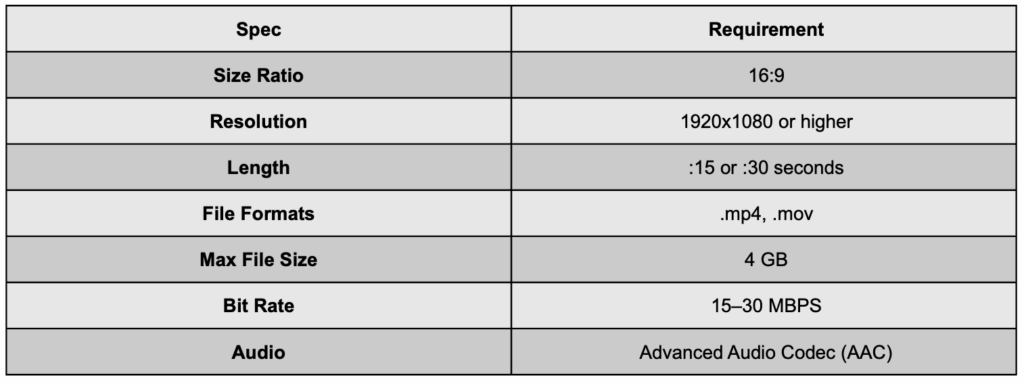
Because CTV is a premium channel, the technical specifications matter. Ads need to be produced at broadcast quality with the correct formatting, resolution, audio encoding, and duration. These requirements are non-negotiable, and teams without internal video production resources often hit friction here.
If you have your own production method, here are all the specs to keep in mind while producing:
If you don’t have an internal team for this type of project, consider a provider that offers marketers a creative development process tailored to the CTV environment. Concepting, production, approvals, and refresh cycles can all be handled by industry experts. Intentsify can help connect you to one of our partners in this space.
How Intentsify is Changing the CTV Equation
Intentsify activates CTV in a way that gives marketers confidence, not just in the channel, but in the outcomes it drives.
By combining high-quality intent data, premium inventory, optimization, and transparent reporting, the guesswork disappears. Campaigns aren’t just running; they’re performing.
They influence decision-makers. They accelerate buying journeys. They strengthen multi-channel engagement. And they do it with measurable signals.
The result is a CTV strategy that behaves less like a siloed awareness campaign and more like a performance engine.
CTV Requires Strategy, Not Just Spend
Anyone can “run CTV.” Purposeful marketers maximize its influence across a full buying journey. They invest in the creative. They prioritize intent-driven targeting. They measure lift, not clicks. They let the algorithms work. The teams that win with CTV understand its true power as part of a multi-channel strategy.
CTV is not the future of advertising. It’s the present, and the marketers who understand how to activate it now will build a lasting advantage as the landscape continues to evolve.
FAQs
How does CTV advertising drive pipeline acceleration and not just brand awareness?
Unlike traditional TV, modern CTV advertising is performance-oriented. By leveraging intent data and Account-Based Marketing (ABM) strategies, marketers can target specific buying committees at in-market accounts. This precision ensures that high-impact video ads influence decision-makers actively researching solutions, accelerating their journey and improving downstream metrics like site visits, engagement across other channels, and time-to-pipeline.
How does combining Intent Data with CTV targeting give us a competitive advantage?
Intent data solves marketing’s hardest challenge: timing. Instead of broadly targeting a job title, intent data identifies which companies are actively researching solutions related to your offering right now. Pairing this signal with CTV enables you to reach the right person at the right company at the exact moment they are in an active buying cycle, leading to highly efficient ad spend and stronger message recall.
Are there technical compliance hurdles or production costs we should anticipate for CTV creative?
Yes, CTV requires broadcast-quality technical specifications for resolution (often 1080p or 4K), audio encoding, and specific file formats. These requirements are stricter than those for social media or YouTube. Teams without in-house video production capabilities should budget for external creative partners or leverage platforms that offer creative development as part of their ad solutions.