
If you’ve ever poured hours into keyword research only to end up with traffic that doesn’t convert, you’re not alone. Ranking is great, but ranking for intent is what drives pipeline.
Modern SEO isn’t about chasing volume anymore. It’s about reading digital body language and figuring out why someone searches, not just what they type. When you understand the “why,” you can design content that meets buyers exactly where they are in their decision process, then gently (and strategically) guide them toward your solution.
In this guide, we’ll break down a step-by-step process for turning search intent into pipeline. You’ll learn how to cluster keywords around real buying behaviors, map those clusters to the funnel, and use them to plan content that actually moves revenue — not just rankings.
Step 1: Stop Treating Keywords as Words, and Start Treating Them as Clues
Every keyword is a data point. But together, they tell a story about what your audience is trying to do.
The old SEO mindset says:
“We need to rank for ‘best CRM software.’”
The intent-driven mindset says:
“Someone searching ‘best CRM software’ is comparing vendors. They’re evaluating features, pricing, and trust signals, which means they’re mid-funnel and close to a purchase.”
When you start reading keywords through the lens of intent, you start seeing how people move through their journey, from curiosity to commitment.
The four core search intents you’ll work with are:
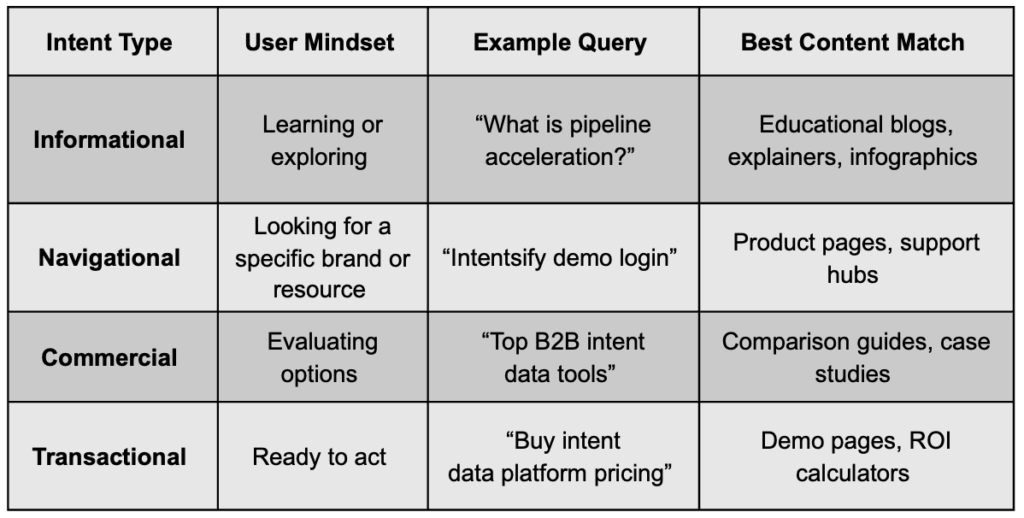
The goal? Build content clusters that intentionally bridge those moments together so when someone moves from “what is intent data” to “best intent data tools,” you’re the brand that stays with them the whole way.
Step 2: Cluster Keywords by Intent, Not Just Topic
Keyword clustering isn’t new, but most teams do it wrong. They group terms by subject, not stage of intent.
Let’s say you sell B2B marketing automation software. A basic topic cluster might include:
- “email automation”
- “marketing workflows”
- “AI email tools”
That’s fine for SEO volume, but it tells you nothing about where the searcher is mentally.
Now, let’s re-cluster by intent instead:
- Awareness (informational): “how to automate email follow-ups,” “why marketing automation matters”
- Consideration (commercial): “best AI email automation platforms,” “HubSpot vs. Marketo for SMB”
- Decision (transactional): “marketing automation demo,” “Marketo enterprise pricing”
See the difference? Instead of a pile of keywords, you have a map of buyer psychology.
Pro tip: Run this exercise monthly. Search intent evolves fast — and staying on top of how your buyers phrase their problems helps your content stay relevant and revenue-driven.
Step 3: Turn Intent Clusters Into Content Tracks
Once you have your clusters, it’s time to transform them into content that aligns to real buying journeys.
Here’s a simple system to guide planning:
1. Awareness Tracks:
- Focus on education, trends, and early problem definition.
- Metrics: organic traffic, newsletter sign-ups.
- Example: “What Is Buyer Intent Data (and How It’s Changing B2B Marketing).”
2. Consideration Tracks:
- Focus on credibility and comparison.
- Metrics: engagement, demo clicks, return visits.
- Example: “Intent Data vs. Lead Scoring— — Which Drives Better Pipeline?”
3. Decision Tracks:
- Focus on validation, proof, and urgency.
- Metrics: demo requests, contact forms, influenced pipeline.
- Example: “How Intentsify Helps Marketers Identify Real Buying Groups.”
This is also where intent data providers like Intentsify come into play. Intentsify surfaces which accounts are actively researching your topics right now — so you can prioritize content tracks that match live market demand.
Instead of guessing what to publish, you’re reacting to real-time buyer intent signals and creating content that mirrors what your audience is researching today.
Step 4: Match Intent to Funnel Stages (and Fill the Gaps)
You’ve probably seen the classic funnel: Awareness → Consideration → Decision.
But intent doesn’t move neatly downward — it zigzags.
Someone might discover you through a “how to” post, jump to a “best tools” roundup, then bounce back to pricing. That’s normal. Your content just needs to be ready for each step.
To make it visual, create an Intent-to-Funnel Matrix like this:
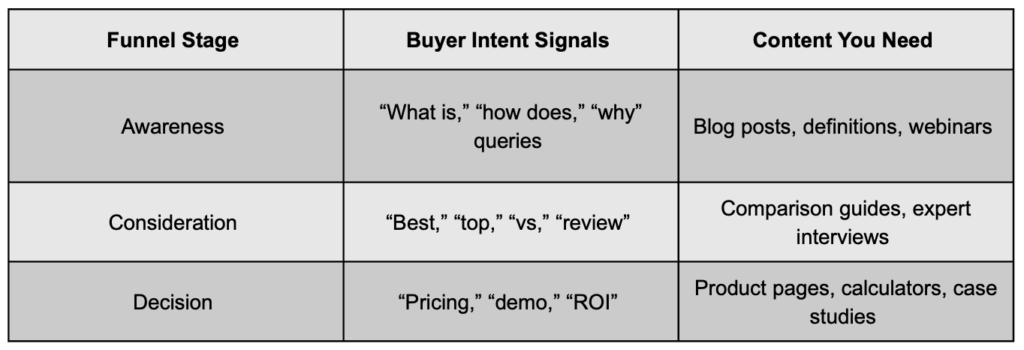
Now look for gaps. Do you have tons of educational blogs but nothing that converts mid-funnel traffic? Are you ranking for “best [your category]” but sending readers to generic blogs instead of gated proof assets? This exercise keeps your SEO strategy aligned with revenue, not vanity metrics.
Step 5: Use Intent Data to Prioritize Topics That Convert
Here’s where things get tactical. You’ll never be able to produce content for every keyword. So focus on the ones that signal the highest purchase readiness.
Tools like Intentsify analyze third-party behavioral data like which companies are reading, searching, and engaging around specific topics.
That means you can:
- Spot which keyword clusters are trending among your ICP (ideal customer profile).
- Identify real buying groups researching your solution, not random browsers.
- Align sales and marketing on which topics are heating up right now.
Example:
If Intentsify shows multiple enterprise accounts spiking in activity around “AI-driven lead scoring,” you know two things:
- The market’s interested — time to publish a guide and promote it.
- Sales should use that same messaging in outreach for relevance and timing.
Intent data makes your SEO calendar proactive, not reactive.
Step 6: Optimize Content for Conversion Paths, Not Clicks
Here’s the hard truth: traffic that doesn’t convert is just expensive noise. To connect intent-driven search to pipeline, every page needs a logical next step tied to where the visitor is mentally.
Examples:
- Awareness content → “Download the checklist” or “Subscribe for more insights.”
- Consideration content → “See real customer results” or “Compare tools.”
- Decision content → “Book a demo” or “Get your ROI estimate.”
The CTA should always feel like a natural continuation of the reader’s thought process — not a hard sell. And if you’re using intent insights to see that a visitor’s company is already showing buying signals, you can personalize that experience even more — showing them proof assets, case studies, or ROI calculators automatically.
That’s the bridge between SEO and sales activation.
Step 7: Align SEO, Content, and Sales Around Shared Intent
Intent data doesn’t just help marketing — it transforms collaboration.
Here’s how to operationalize it:
- Weekly Intent Stand-Up: Review which topics are surging (from tools like Intentsify) and align content + sales messaging.
- Shared Content Library: Organize assets by buyer stage and intent signal so reps know what to send when an account engages.
- Feedback Loop: Sales shares what messaging resonates; marketing adjusts keyword targeting and copy accordingly.
This alignment turns your website into an extension of your sales enablement process, because the same intent data that drives your SEO roadmap also tells sales who to call and what to talk about.
Step 8: Measure What Really Matters
Rankings and clicks are nice, but intent-driven SEO demands better KPIs.
Track metrics that show progression, not just discovery:
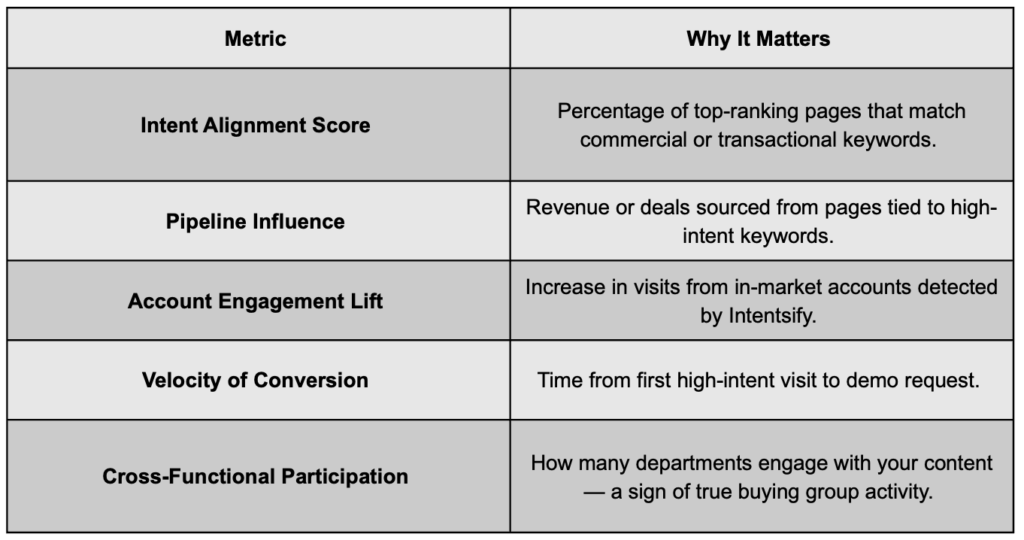
When you track these instead of vanity metrics, you can directly tie content planning to pipeline outcomes.
Step 9: Create a Repeatable, Predictive Engine
Intent doesn’t stop at content creation. The best marketing teams turn it into a continuous feedback loop.
Here’s the monthly rhythm to aim for:
- Collect: Use SEO and intent tools to identify trending topics and surging accounts.
- Cluster: Group those signals by funnel stage and buyer job.
- Create: Publish or refresh content that matches that behavior.
- Activate: Distribute via email, ads, or outreach—targeting active buying groups first.
- Measure: Track account engagement, conversion paths, and influenced revenue.
- Refine: Feed results back into your next month’s planning.
It’s SEO meets ABM meets demand generation—all powered by understanding what people search and why they search it.
Step 10: From Keywords to Conversations
Turning search intent into pipeline is ultimately about empathy. It’s not about hacking algorithms; it’s about listening to what your audience is already telling you — and showing up with the right answer, at the right time.
Intentsify makes that easier by revealing where the market’s attention is shifting, which companies are actively researching, and how those signals change week to week. But the strategy still comes down to humans—marketers who know how to translate that insight into stories, guides, and proof points that build trust.
When you connect those dots—search → intent → content → pipeline—you stop chasing keywords and start leading conversations that turn into revenue.
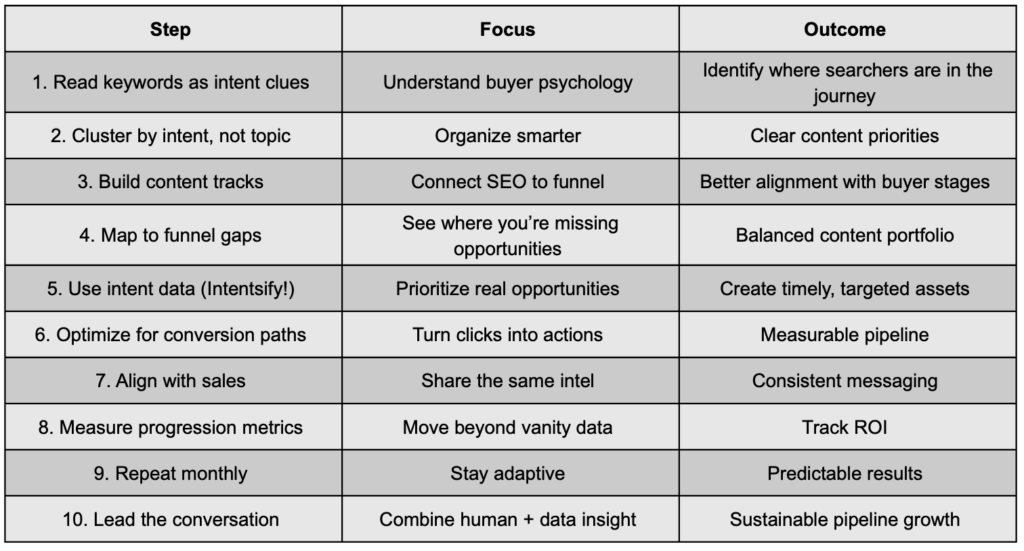
Quick Recap: The Intent-to-Pipeline Blueprint
TL;DR
Search intent is the truest expression of buyer curiosity—and the cleanest path to pipeline when you treat it that way. Use keyword clusters to decode what people want, intent platforms like Intentsify to see who’s actively researching, and content strategy to deliver why you’re the best solution. That’s not SEO. That’s modern demand generation, and it starts with intent.
FAQs
How does shifting our focus from ranking for volume to ranking for search intent to pipeline specifically affect deal velocity?
This shift significantly accelerates deal velocity by ensuring Marketing is only creating content for active buyers. Instead of passively waiting for an MQL, the system identifies commercial and transactional intent (e.g., “best tools,” “pricing”). This means Sales outreach is automatically triggered with hyper-relevant content that aligns precisely with the prospect’s current research phase, dramatically shortening the time between the initial high-intent search and the demo request.
We have a large content library. How do we quickly identify which content we should retire versus which assets we need to create immediately to maximize this strategy?
You need to perform a simple Intent-to-Funnel Matrix audit (Step 4). Identify your high-ranking informational content (Awareness) and compare it against your transactional keyword performance. The immediate content gap is usually in the Consideration and Decision stages—specifically, comparison guides, ROI calculators, and case studies that validate your solution. Prioritize creating content that converts mid-funnel traffic into demos.
What is the critical technology required to move beyond manual keyword clustering and scale this predictive engine for our entire GTM team?
The critical technology is an Intent Data Platform (like Intentsify) combined with your existing SEO tools. While SEO tools identify what people search, the Intent Data Platform identifies which target accounts and buying groups are actively searching. This intelligence allows the content engine to move from a manual process to an automated, signal-based system, ensuring Marketing and Sales are always aligned on which topics are surging and which high-value accounts to prioritize.
What is the most important measurable outcome of aligning SEO and Sales around the same intent data?
The most important outcome is Cross-Functional Participation and a measurable increase in Pipeline Influence. When Sales knows exactly what research topics are hot—using the same data that fed the SEO calendar—their outreach is timely and relevant. This turns your website into a powerful sales enablement tool, generating more influenced pipeline and improving the overall quality of sales conversations.